












What Exactly is a Free Market?
What do we mean by “free markets” or even “capitalism” for that matter? It’s probably not what you think. For many people, these terms conjure images of Wall Street bankers and multinational corporations. Perhaps they also bring to mind small businesses and scrappy startups. All of those are part of free market capitalism, but they’re only one piece of the puzzle.
To understand the whole picture, you need to start with a single individual.
Start with yourself. You have hopes and dreams, talents and passions. You want to build a life that brings you and the ones you love happiness and excitement even as you achieve independence and stability. Ultimately, you want to build a life with meaning, filled with purpose. Everyone of us wants that for ourselves. And for each one of us, that life looks as unique and diverse as we all are. For all the things we share as a community and a society, there is no getting around the fact that each of us values different things at different times in different ways. One person’s trash is another person’s treasure. No one can know you as well as you know yourself. The same is true for every one of us.
So here you are, a unique individual, out in the world trying to figure out life. Doing it the “free market” way means following three pretty simple rules.


Those are the rules of the free market: so long as you don’t hurt other people or steal their stuff, and so long as you keep your word, you’re free to do whatever you want. You’re free to work for whoever you want. You’re free to love and marry whoever you want. You’re free to worship whoever or whatever you want. You’re free to trade with whoever you want.
And with this freedom, you’re empowered to take on any problem you want to. Free markets destroy the problems in our society because they empower free people to destroy those problems and offer new solutions. Free markets empower everyone, but especially underdogs, upstarts and immigrants to take on the status quo precisely because they don’t need to seek permission first. Free markets don’t respect traditions unless those traditions are maintained peacefully. Free markets are the most radical, revolutionary force for change humanity has ever discovered. And the reason is simple. Free markets are nothing more and nothing less than each of us and all of us having the right to try our best at improving everything for each other.



 Boredom is a luxury good. For most of human history, we couldn’t afford to be bored. We were too busy hunting, foraging, fighting, mending—simply surviving. In fact, the English word “boredom” didn’t exist until the 19th century when philosophers like Søren Kierkegaard and Friedrich Nietzsche began to grapple with the existential challenge of filling up the leisure time free markets had created.
In the United States, the average work week has plummeted from 61 hours in 1870 to less than 35 hours today. According to the CDC, Americans now spend more than 5 hours per day “being entertained, socializing, engaging in exercise and recreation activities, volunteering, taking classes for personal interest, and travelling.”
Americans now spend almost one-third of our waking hours relaxing. And the reason, in a word, is markets. Not only did free markets make our work more productive, they forced employers to compete. As a result, companies and bosses started offering better pay, shorter days, and, in the modern era, opportunities for time-saving remote work. Since 1950, global per capita work has decreased 17%, from 2,227 hours a year to 1,855. During that same period, inflation-adjusted income has increased 111%. That means on average we are earning twice as much while working significantly less.
So the next time you’re bored, blame free markets. Then pick up an iPhone, or a Kindle, or an Xbox.
 Thank you for subscribing to Free Markets Destroy.You’ll hear from us soon.
 Thank you for subscribing to Free Markets Destroy.You’ll hear from us soon.
 In a free market, there are no sacred cows. In 2004, Blockbuster operated more than 9,000 stores, collecting $800 million in revenue from late fees alone. Seven years later, the cash-strapped company announced plans to close all of its remaining stores within a few months. From behemoth to bankrupt in a decade, that is the power of free markets.
To be specific, that’s the power of Netflix, Hulu and YouTube. Competition is the engine that powers progress in markets, and thousands of companies are competing for the right to keep us entertained, informed, and happy. But there’s a catch, something economists call “subjective value.”


At its core, subjective value is simply the belief that everybody has unique preferences. Subjective value explains why some people love jazz, or poetry, or the movie Die Hard, while others can’t stand them. Products, including TV shows, books and games, don’t have innate value. Their value depends on the subjective preferences of individuals like you. And preferences change over time. That’s why Blockbuster can be worth billions in 2004 and pennies just a few years later.
In the past few decades, as technology made it easier for content creators and distributors to find an audience, we’ve witnessed an explosion in the number and variety of products designed to fill our leisure time. With nothing but an iPhone and an internet connection, you can access YouTube, Instagram, or TikTok—the entire internet is at your fingertips. You can connect with friends on Discord or learn French on DuoLingo. You can meditate with Headspace or search for recipes on Tasty.
 `
`
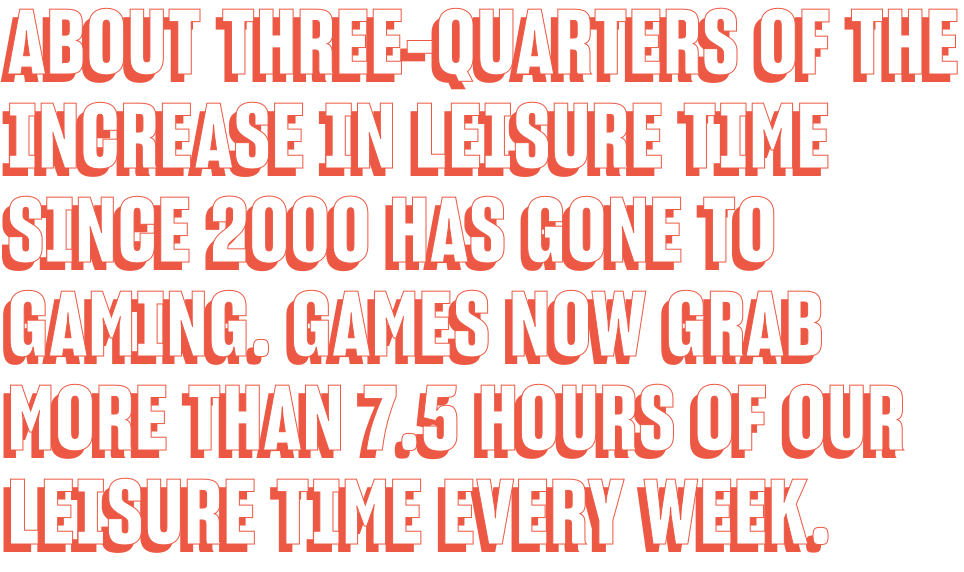
About three-quarters of the increase in leisure time since 2000 has gone to gaming. Games now grab more than 7.5 hours of our leisure time every week. What was once a niche industry serving a small but dedicated fanbase has become a $120 billion juggernaut. And thanks to innovations like Twitch, the live-streaming platform acquired by Amazon for $970 million, thousands of gamers have been able to turn their hobby into a source of income as they compete and collaborate with other players from around the world.
In the 19th century, the problem was that we didn’t have anything to do with all of our newfound free time. In 2020, the problem is that we have too much to do. In 2019, Netflix released a new original title every single day. That’s more new content than the entire TV industry combined produced in 2005.
More, better, cheaper, and something for everyone—that’s the power of markets to improve everything.



A project of
WASHINGTON POLICY CENTER
